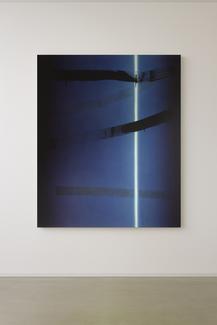
Humming the World Nicolas Delprat
Dates : Dimanche 6 septembre 2026 - Samedi 24 octobre 2026
Vernissage : Vernissage Dimanche, 6 septembre 2026 - 14:00
Adresse : Michèle Schoonjans Gallery, 690/25 Chaussée de Waterloo, 1180 Bruxelles
Michèle Schoonjans Gallery
690/25 Chaussée de Waterloo
1180 Bruxelles
Belgique
Description, horaires...
Hans Theys - curator
Humming the world
On the work of Nicolas Delprat
I’d like to begin this text with a strange question. If the work of Nicolas Delprat (born 1972) didn’t speak about art history and the production of artworks—which it certainly does—what would it tell us? What story is being concealed here?
“I’m fascinated by memory,” he says, “for example, when it invents images. In my memory, my favourite scene in Taxi Driver was the moment Travis Bickle shaves his head. But when I recently rewatched the film, it turns out this scene doesn’t exist at all. You see Bickle running up the stairs to his apartment and returning with his head shaved. Scorsese has employed an ellipsis: the actual action isn’t visible and is only suggested. I hope to do something similar with my work. It often starts from things seen, but I don’t want to recreate them. I use them as starting points for minimal work that can evoke stories or images in the viewer.”
This means we are free. But we can also fantasise about the unspoken images that Delprat, consciously or unconsciously, wants to evoke. The nonexistent scene in which Bickle shaves his head is very physical, martial, and radical. The result is an early Lucio Fontana; a bristly Onement by Barnett Newman.
However, if we look at Delprat’s way of working, we find a different underlying narrative—one that says something about painting, but also about action, life, and thought. In summary, we can say that he paints in two ways: very meticulously and very freely. Between these two actions lies a vast, unexplored zone, a field of untapped possibilities. This creates paintings in which this choice can be read. They tell us something about painting, but also about being. Below, I will say more about the different ways of painting and the importance of meta-paintings. But first, I want to say something about this way of being.
If we view the painting as the trace of an action, we encounter a person who works very cautiously and attentively—like Agnes Martin, for example: slowly, repetitively, meditatively. And then we see drips, splatters, and large traces of brushstrokes, which reveal various forms of letting go. The drips have something sensual and tactile; the splatters and brushstrokes evoke a more far-reaching physicality: an eruption, a release, or a broad arm movement. Here too, we discover the body, as we did with Bickle, almost hidden from view by an ellipsis. Simultaneously, we read a story of relinquished control, of growing trust and self-confidence, of restraint and decisiveness.
With the exception of one series (the Dynamique paintings on paper, created during a residency when canvas was out of reach), all of Delprat’s works begin with a smooth, white polyester canvas that is first primed with a white base coat and then completely or partially covered with a matte black acrylic paint applied with a spray gun. The figures or optical effects (fluorescent light tubes in the ‘Dan' series, doorways in the ‘James’ series) are created by layering numerous layers of diluted acrylic paint over this black. Only after the fortieth layer do these additions become visible; usually, around sixty layers are applied. Thus, light is reclaimed from the black. It is an illusion, a painterly magic trick.
Most optical effects are created this way: slowly, applied with a small brush. A stunning example of this can be found in the paintings featuring a representation of chicken wire. The ‘chicken wire’ is the trace of an overpainted black background (created by spraying lighter colours over actual chicken wire laid over the canvas). Where the wire is no longer visible, or where it appears fainter, it has been painted over by dabbing with a very small brush.
The constantly evolving ‘Dan’ and ‘James’ series, whose titles refer to the minimalist light sculptures of Dan Flavin and James Turrell, are based on memories of experiences with these sculptures. The Dan series evokes the image of luminous fluorescent tubes, each time in a different composition. Turrell worked with sunlight, Flavin with artificial light. In Delprat’s paintings, we don’t see real light, of course, but a reconstruction of a memory—the creation of an illusion.
The beauty of the pairing of meticulous and more decisive, rapid actions is that they create a pictorial space that seems to unfold at different depths. The gradients and other atmospheric backgrounds are pushed into a fictional background by actions that seem to take place in the foreground: splashes of paint thrown next to the canvas, broad traces of paint (applied with a wide, thin brush), or a fake passe-partout painted at the end with black acrylic paint. The absence of “mixed forms” between the meticulous and the robust makes this pictorial depth highly legible, meaning that the painting also tells us something about the composition of paintings. Another way to do this is by leaving traces of tape.
The absence of perspectivisch depth or volume modulation reminds us of the American abstract expressionists (Newman, Reinhardt, Rothko, Pollock), but also of Supports/Surfaces and BMPT. The pictorial space created by differences in texture and colour intensity is reminiscent of the early watercolours of Soulages or the twirling paintings of Christopher Wool. The overpainting of “expressive” elements such as drips is reminiscent of Hans Hartung. Together, these painters form the interlocutors with whom Delprat converses.
I enjoy being in this kind of company. There’s not much noise. There’s whispering. There’s experimentation. There’s fiddling, struggling, cursing, and enjoying. It’s a very solitary activity, but the silent conversation with other painters, sculptors, filmmakers, and writers simultaneously alleviates this loneliness. In the stillness, we merge with the others.
A magic trick also takes place—a secret exchange. The whole world, with all its heaviness, volume, murmur, movement, desire, and transience, is conjured away, yet evoked in a gentle or decisive gesture. In a soft singing, a humming of existence. (For what do we call a song without words, without meaning-distinguishing sounds, without recognisable images?)
My favourite paintings are the dynamic “landscapes”. I love their atmospheric, seemingly dissolving backgrounds and the almost uncontrollable splashes that seem to play out in the foreground. Once the background is finished, Delprat throws a large blob of paint next to the painting in such a way that the splashes appear to point in a single direction, creating an illusion of movement. We know that Bacon also finished paintings by throwing a dab of white paint on to them, which gives the whole scene a new depth. The art critic David Sylvester asks Bacon whether his cleaning lady could throw the paint in his place. Bacon confirms. Then Sylvester asks if he himself could throw the paint. “No, you couldn’t,” Bacon replies. At least, that’s how I remember it. But upon rereading the interviews, I couldn’t find this passage. I probably made it up.
Montagne de Miel, 6 January 2026